Monitoring the Ecological Corridor of the Bakossi National Park and Banyang-Mbo Wildlife Sanctuary to Understand the Habitat Use and Migration Pattern of Drill Monkeys and Nigeria Cameroon Chimpanzees in South West Region, Cameroon.
The Bakossi National Park adjoins the Bayang Mbo Wildlife Sanctuary to form Kupe
Muanenguba forest landscape, an important zone for the protection of primates and the
African rainforest habitat of the Guinea-Congolian basin. The Bakossi National Park (BNP)
is a protected area located at 5.049907°N and 9.567719°E, covering a surface area of 29,320
hectares (72,500 acres). It have the largest zone of cloud or sub-montane forest in West Central Africa (Royal Botanic Gardens, 2011). It has one of the best developed sub montane
forest in West Africa and rich in montane endemics of Guinea-Congolian affinity (Kew
Gardens, 2010). It is a unique hotspot for many primate species, including the Drill
(Mandrillus leucophaeus), one of the most endangered primate species in the world, and the
Chimpanzee (Pan troglodytes). Other primates include Preuss’s red colobus, Red-eared
guenon, Preuss’s guenon, Putty-nosed monkey, Mona monkey and mammals like Blue
duikers, Red river hog, Red-fronted duiker, Black-fronted duikers, Sitatunga, and Long tail
pangolin, African forest elephant, (WWF Coastal Forest Programme, 2012).
This project sought to establish grounds for long-term collaborative conservation of Drills and
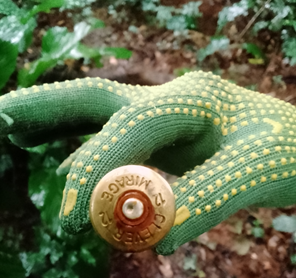
Nigeria Cameroon Chimpanzees in the Bakossi National Park by filling the gap in field surveys created through Cameroon’s Socio-political unrest (Anglophone Crises). This project was a pilot survey focusing to train and test the efficacy of engaging Bakossi locals with good Ecological Knowledge as social scientists, for the monitoring of the ecological corridor linking the Bakossi National Park and the Bayang Mbo Wildlife Sanctuary in order to provide information on population, distribution, habitat use and threats to these primates that are endemic in this area.
Additionally, the unrest has hindered effective protection of the protected area from hunting and habitat degrading activities like logging, farmland encroachment and bushfires due to
government agents of Forestry and Wildlife inability to access this zone. This has created a
double facet conservation need; in data acquisition and wildlife surveillance, and anti-poaching.
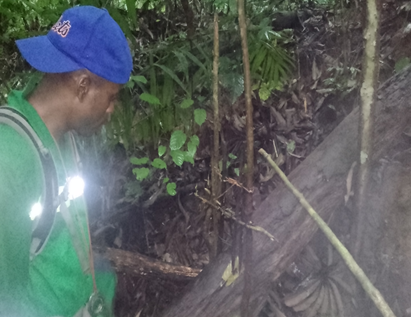
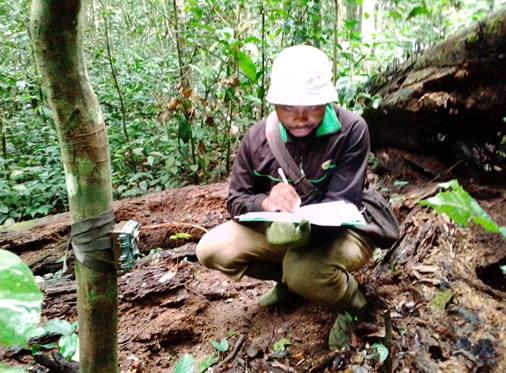
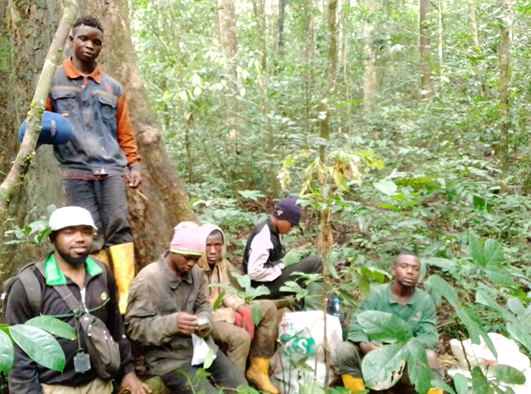
It is in response to this halt of scientific research and challenges of government patrols that there is need for funding to support the training and to closely work with the locals of these communities. This Project trained 04 local community field researchers in the use of camera traps, GPS, Cyber Trackers, data gathering along transects and anthropogenic,
assessments and deploy them in the field for monitoring along the corridor.
FReECo focuses to promote the long-term conservation of threatened Chimpanzees and Drills in the Bakossi National Park through local empowerment, collaboration, and participation.
Wildlife conservation law as ‘class A’. Their habitats are under threat of degradation and fragmentation by human activity such as deforestation, farmland encroachment and bushfires. Literature has it that one Pangolin could consume more than 7 million of termites or ants annually (Challendar, 2009). The existing habitat disturbance as recorded during previous studies (Field observation of 2020/2021) threaten their welfare in their habitats, reduce food availability, and foraging capacity (Difouo et al., 2020) and reproduction leading to the local extinction. There is a limited number of government personnel charged biomonitoring of the park and to take off snares used to hunt pangolins. Thus, training of local guides as community rangers is vital for the biomonitoring and conservation of pangolin in Deng-Deng. The DDNP is in the Northern Congolian forest-savanna mosaic ecoregion situated against the forest of the Eastern Region and the desert of the Adamawa Region.
Project outcome will help to understand the efficacy of using locally motivated individuals as citizen scientists to protect pangolins, thereby enabling forecast of potential period for species population and habitat restoration.
Though the project is still at its early stage, thanks to the Mohammed Bin Zayed (MBZ) Species Conservation Fund, 06 local field assistants have already been trained in biomonitoring of pangolins using SMART survey tools; camera trapping, GPS, cyber-tracking, and data collection and recording on field data forms. They have also been educated on environmental and research ethics which is necessary to provide reliable and consistent research information. The local assistants now function effectively as citizen scientists (Couvet et al., 2008; Eden, 1996); and will be supported in providing consistent information and biomonitoring data to support pangolin welfare in Deng-Deng. The transformed local field assistants are now monitored, and will be certified as Community Rangers coordinated under FReECo in order to collaborate with government owned Eco-guards who are limited in number. Their collaboration will sustain an efficient conservation and ecosystem free of human interference including removal of trapping devices, destruction of hunters’ houses, recording of every human signs, document pangolin and other species signs their habitat use and evolution. In future more disengaged hunters will be recruited. This project targets to establish a standard community-based collaborative monitoring system based on feedback and rapid intervention response towards human activities, pangolin ecology, population status and other field reports.